Turning Customer Research Into Ideas Worth Building
- Matt Adams
- Mar 11
- 3 min read


The Problem With Brainstorming
Most ideation sessions follow the same pattern. A room (or Zoom) full of smart people, a whiteboard, and a prompt that's vague enough to generate lots of ideas but not focused enough to generate useful ones. You walk out with a long list, a few sticky notes that made everyone laugh, and a nagging sense that none of it quite connects to what your customer actually needs.
At M&T Bank, we'd done the research to understand our small business customers and defined the four jobs-to-be-done that shaped our strategy. The question became: how do we translate that into ideas worth building?
The answer was to make the customer the constraint — not an afterthought.
Using Jobs-to-Be-Done as an Ideation Filter
Once we had our four jobs defined, we used them as the organizing framework for every ideation sprint. Instead of asking "what should we build?", we asked "which of our customers' jobs does this idea actually address — and how well?"
That shift changed the quality of ideas coming out of sessions. It gave the team a shared filter for evaluating concepts in real time, which meant less time debating opinions and more time stress-testing ideas against something concrete. If a proposed solution couldn't be connected back to a job, it didn't make the cut.
We also brought in internal stakeholders from across the bank — not just marketing — to widen the perspective. Product, community banking, and diversity and inclusion teams all contributed. Cross-functional ideation isn't always easy to coordinate, but the ideas it surfaces are almost always better than what any single team produces on its own.
The Multicultural Sprint: A Case Study in Customer-Centered Ideation
One of the most meaningful ideation threads we pursued came out of a specific insight from our research: minority entrepreneurs were filing to start new businesses at higher rates than any other group, yet they faced the most barriers in actually getting those businesses off the ground.
That gap was a real opportunity — not just commercially, but as a way for the bank to show up meaningfully in communities that had historically been underserved by traditional financial institutions.
We ran a dedicated ideation sprint focused on this segment, working alongside the bank's newly formed multicultural team. We built out a realistic target customer profile and asked: at each stage of starting a business, where can the bank genuinely help?
Two ideas rose to the top. The first was an in-person educational series to help aspiring entrepreneurs understand the fundamentals of running a business. The second was a pitch competition — a Shark Tank-style event with prize money to help early-stage owners get a real financial jumpstart.
We stress-tested both against the jobs-to-be-done framework before moving forward. The goal wasn't to pick the most exciting idea. It was to pick the ideas that hit on the most jobs simultaneously and had the clearest path to impact.
From Idea to Reality

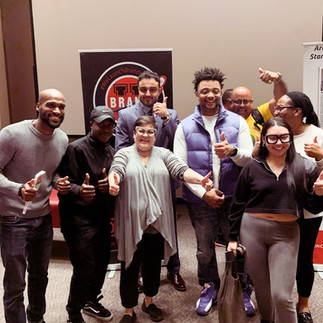



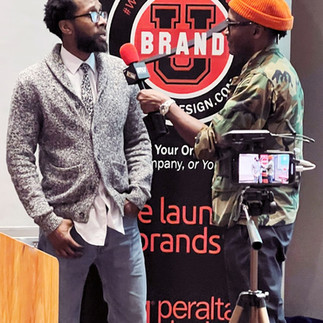

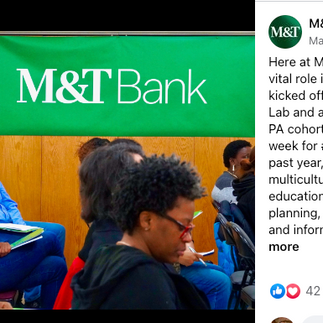

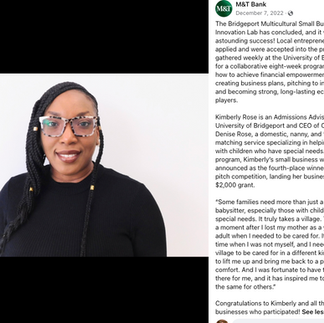

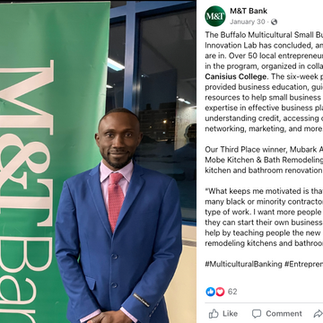
We piloted both programs in the bank's home market first, using in-branch marketing and partnerships with local colleges to drive awareness. Dozens of participants joined the weekly educational sessions. The pitch competition drew strong applications, and winners shared their stories publicly — which created its own organic momentum.
We expanded to Bridgeport, CT and Harlem, NY. Larger markets meant slower initial traction, so we leaned harder into the pitch competition and raised the prize amount. Engagement picked back up. The programs found their footing.
Not every idea from the sprint made it to launch. A self-serve lead routing tool — designed to match prospects with the right banking products based on their business type and needs — was prototyped but ultimately handed off to a third-party vendor. The MVP fell short, in-platform data was difficult to capture, and after a year without a clear ROI, we made the call to end the partnership. That outcome was its own lesson: a well-framed idea still needs the right infrastructure to succeed.
What I Learned
Ideation works best when it's bounded. The more clearly you understand your customer's jobs, the more productive your brainstorming becomes — because you're not starting from scratch, you're solving a defined problem.
The multicultural sprint also reinforced something that's easy to say but harder to practice: the customers most underserved by your category are often the ones with the most to gain from a thoughtful solution. Designing for them isn't a detour from your growth strategy. It often is your growth strategy.
Building a new engagement program or trying to make your ideation process more customer-centered? Get in touch — it's one of my favorite problems to work on.
Related posts:
Why Customer Research Should Come Before Your Marketing Strategy
Designing Engagement Journeys That Reduce Churn and Build Loyalty (coming soon)


Comments